
In Michigan, gun charges can arise from a number of different contexts. They include but are not limited to:

  • Carrying a concealed weapon
  • Carrying a dangerous weapon with unlawful intent
  • Illegal discharge of a weapon
  • Illegal possession of a firearm
  • Felon in possession of a firearm

Although most gun crimes are connected to other illegal activities such as armed robbery, assault, and murder, people have been charged even if they possess a valid permit such as a concealed pistol license (CPL) and did not intend to do anything illegal. For example:

  • Firing a gun outside to celebrate a holiday such as New Year’s or the Fourth of July
  • Forgetting that they have the gun on them when they walk into certain buildings, such as schools, courthouses, and post offices

In general, any person who carries or uses a gun recklessly without taking the safety of others into account can be charged with a misdemeanor. In more extreme causes, felony charges can even levied.

If you are charged with a gun crime in Michigan, here are four things you must do either immediately or as soon as circumstances permit.

Show Your Concealed Pistol License

A concealed weapons charge arising from a pistol found on your person can be challenged if you demonstrate to the police that you are licensed to carry in the state of Michigan. Even if you do not have a license, Michigan law allows you to carry a concealed firearm or other weapon in your home, place of business, or other land that you own.

Call an Attorney

Anyone charged with a gun crime needs to call a Michigan defense attorney with experience in defending gun crimes. They will review the circumstances of your arrest and determine the best possible defense strategy. For example: you may have been carrying an inoperable firearm, and the arresting officer’s understanding of the statutory definition may be erroneous.

Get Your Gun Rights Restored Under State Law

If your gun rights are revoked as a result of the charges, the process of restoring them depends on the situation in which they were originally taken from you. Individuals convicted of most felonies can generally have their gun rights restored three years after they have paid all fines, served any sentence imposed, and completed all conditions of probation or parole. Certain specified felonies punishable by four years or more in prison require a five-year waiting period.

Restore Your Gun Rights Under Federal Law

If you lose your firearm rights under state law you are also likely to lose them under federal law, and restoring them is a lot more complicated. Essentially, you must get a pardon or record expungement before your gun rights are restored at the federal level. Your gun crimes defense attorney can assist you in this regard.

If you are charged with a gun crime in Michigan, call the Michigan Gun Law today. We understand the intricacies of Michigan criminal law when it comes to gun offenses and will present the strongest defense for your particular circumstances.

~Originally posted in November of 2016~
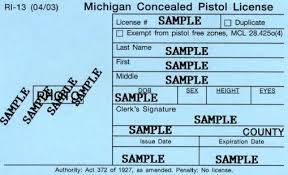
Both the Michigan State Constitution and the Second Amendment confirm and protect the rights of all citizens to own and bear arms. Michigan is a “shall issue” state, meaning that any person who meets certain criteria and requirements may obtain a concealed pistol license.

State Requirements

All concealed carry pistol license (CPL) applicants must be:

  • 21 years of age or older
  • Either an American citizen or legal resident of the United States
  • A resident of Michigan for at least six months prior to applying. This six-month requirement may be waived under emergency conditions (e.g. your safety or that of your family depends on your receiving a CPL or if you hold a valid CPL issued by another state at the time your Michigan residency is established.

In addition, you must have successfully completed an approved pistol safety training class or course.

You will NOT be issued a CPL if you have experienced or are the subject of any of the following:

  • A felony conviction in Michigan or elsewhere
  • A personal protection order
  • Legal incapacitation
  • Involuntary hospitalization; however, there is a recent Sixth Circuit Court case that addresses this issue, which this firm will explain how the court’s decision will apply.
  • A declaration of not guilty by reason of insanity
  • A conditional release or bond that prohibits the possession of a firearm
  • Dishonorable discharge from the United States Armed Forces

Pursuant to MCL 28.426, you also may not receive a CPL if federal law prohibits you from possessing or transporting a firearm.

How to Apply

After completing the required pistol safety training course, you must file a copy of the CPL application at the county clerk’s office in the county where you live. The application has to include:

  • A certificate stating that you have completed an approved pistol safety training course
  • A passport-quality photograph

Many county clerk offices request that you submit this paperwork within six months of having taken a pistol safety training class.

Upon paying all necessary fees and filing the application, you must be fingerprinted by the county clerk, sheriff’s office, state or local police, or other approved agency. The county clerk shall issue your CPL or notice of statutory disqualification within 45 days after the date your fingerprints are taken. Once issued by your county licensing board, your permit is valid for three years.

For assistance with applying for your concealed pistol license, contact Michigan Gun Law today. We will answer your questions and help you understand Michigan law as it pertains to gun ownership.

~Originally posted in October of 2016~

Both current and aspiring gun owners in Michigan have one thing in common: they need to be familiar with the state gun laws as well as regulations from the Michigan Department of Natural Resources (DNR)  and federal law. Knowledge of applicable requirements, restrictions, and regulations ensures that you are not inadvertently breaking the law while exercising your constitutional right to bear arms.

Gun Ownership in Michigan

No license is required to purchase a long gun (defined as a firearm over 26 inches long) in Michigan. This means that anyone over the age of 18 can buy and possess most shotguns and rifles, provided that they are not disqualified by a criminal record, history of mental illness, or similar disqualifying criteria such as a valid Personal Protection Order (PPO).  Owners of rifles and shotguns need to be familiar with the regulations from the Michigan DNR regarding the transportation and possession of firearms, particularly from October to January.

To purchase a handgun from a state dealer or private seller and if you do not have a concealed pistol license (CPL), you must obtain a license from the chief of police if you reside in a city, or the country sheriff if your area of residence has no dedicated police department. Licenses may only be granted to Michigan citizens who:

  • Are 18 or older
  • Have never been convicted of a felony
  • Have never been declared insane (unless restored by court order)

If you intend to purchase your handgun from a federally-licensed dealer, you must be at least 21, as federal law prohibits them from selling to anyone who is younger.

Open Carry in Michigan

In general, open carry is legal in Michigan. Open carry means that the handgun and holster are completely visible to  the untrained eye, which means the general public.  A holster worn inside your waistband is considered concealed carry.  One significant exception is transporting or  possessing a firearm in a vehicle. If you do not have a concealed pistol license, your gun must be unloaded and taken down, in a case, placed in the trunk,  or otherwise inaccessible to anyone inside the vehicle.

Concealed Carry in Michigan

Michigan is a shall-issue state, meaning that if you qualify for a concealed carry permit, you must be issued one. To qualify, you must:

  • Successfully complete a firearms training course
  • Undergo a background check
  • Be fingerprinted
  • Have no felony conviction or background of mental illness
  • Have no designated misdemeanors in the past eight or three years as listed in the law

Once issued by your county clerk, your permit is valid for five years.

Prohibitions on Gun Carrying in Michigan

Pursuant to MCL 750.234d, you may not carry a firearm in any of the following locations, without a concealed pistol license:

  • Churches
  • Depository financial institutions
  • Courthouses
  • Theatres
  • Sports arena
  • Day care centers
  • Hospitals
  • Establishments licensed under the Michigan Liquor Control Act

Pursuant to MCL 28.425o, a concealed pistol license holder may not carry concealed in any of the following locations:

  • Schools or school property
  • Public or private child care or daycare centers
  • Taverns or similar places that derive their primary income from selling alcohol for on-site consumption
  • Hospitals
  • Churches
  • Sports arenas and entertainment venues that seat 2,500 or more people
  • Dormitory or classroom of community colleges, colleges, or universities

It is also illegal to carry a gun if you are under the influence of alcohol. Michigan law on this matter is even stricter than DUI guidelines, in that you don’t even have to be legally drunk to be break the law. It is recommended that you refrain from carrying if you have had any alcohol at all.

For assistance with your permit application and / or interpreting local and Michigan state laws, contact Michigan Gun Law today. We will help give you peace of mind by ensuring that buying and owning a gun is done in accordance with all applicable gun laws.

~Originally posted on September of 2016~

Unlike some states, Michigan courts define the crimes of assault and battery in context-specific ways. In other words, the offense you are charged with depends on your intent at the time you committed it as well as the actual outcome.

Assault

An altercation becomes an assault when you attempt to injure someone else by striking them with your hand or an object. Even if the attempt doesn’t succeed, it is still considered assault: you can be charged simply for raising your fist or waving a weapon at the person. If the other party has reasonable cause to believe that you intend to harm them, you have committed assault under Michigan law.

Assault and Battery

An assault charge becomes assault and battery when you actually hit the person with your fist or an object. Michigan law defines the difference between ‘assault’ and ‘assault and battery’ because “battery” is a more serious offense. With battery, actual violence was committed because you followed through on the threat or attempt to cause injury. In other words, for a crime to be classified as battery, there must be contact between you and the other person or with an item in the person’s possession. With assault, there does not have to be.

Cases that involve assault or assault and battery are considered misdemeanors if no dangerous weapon is involved. If convicted, you can spend up to 93 days in jail and be ordered to pay a $500 fine.

Aggravated Assault

Aggravated assault is another misdemeanor assault crime, but it is regarded as more serious than assault and battery. This is because your attack resulted in an aggravated injury. Penalties upon conviction include up to one year in jail and a $1,000 fine.

Felonious Assault

Your assault charge could be elevated to a felony accusation if you used a weapon during the alleged assault. A conviction can send you to prison for up to four years and force you to pay a $2,000 fine.

Other felony assault crimes in Michigan include:

  • Assault with Intent to Maim or Intent to do Great Bodily Harm
  • Assault with Intent to Commit a Felony

If you have been accused of assault, assault and battery, or felony assault in Michigan, both your future and your freedom depend upon experienced legal counsel. At the Law Office of Melissa M. Pearce, we have a successful history of assault defense, and will work tirelessly to ensure the best outcome for your case.

Anyone charged with assault in Michigan has the option of pleading self-defense. Michigan Self-Defense Act MCL 780.971-.974 affirms your right to defend yourself or others when you have reason to fear imminent harm.

Michigan’s Self-Defense Act is often referred to as a ‘Stand Your Ground’ law because, under certain circumstances, you have no legal obligation to retreat from an assailant before using deadly force or non-deadly force against them. However, to be clear, MCL 780.972 only provides for two specific situations in which you may utilize deadly or non-deadly force with no requirement to retreat:

  • You “honestly and reasonably” believe that such force is necessary to protect yourself and / or someone else from imminent death or imminent great bodily harm.
  • You “honestly and reasonably” believe that such force is necessary to protect yourself and / or someone else from imminent sexual assault.

In these cases, even if it later turns out that you over-estimated the danger, you may act immediately to defend yourself and continue to act only as long as there is an element of danger. For example, if your attacker is unconscious, there is no reason to keep striking them.

Additionally, MCL 780.973 makes it clear that the aforementioned circumstances provided for in MCL 780.972 are the only circumstances in which deadly force will be acceptable without retreat. Short of either of the two scenarios detailed in the bullet points above, Michigan still recognizes a common law duty to retreat, MCL 780.983.

How Self-Defense Is Interpreted

When you raise the issue of self-defense, the judge will instruct the jury to evaluate your actions according to how circumstances appeared to you at the time of the incident. Factors that are taken into account include:

  • Whether your attacker possessed a dangerous weapon
  • Your size and strength
  • Whether you were injured during the attack
  • Whether the attacker had attempted to injure you on previous occasions

When determining whether the amount of force you used was necessary, juries will consider whether there were other ways of defending yourself. They will also consider how your choices may have been affected by the excitement of the moment. The Michigan Supreme Court once affirmed that if someone is in a state of high excitement brought on by an attack, they cannot be reasonably expected to make distinctions as to the amount of force needed to defend themselves.

You must also not have acted wrongfully in the first place to incite the attack, and you cannot claim self-defense if the altercation took place while you were committing a crime such as a home invasion.

If you have been charged in Michigan and want to present a solid and well-rounded self-protection defense, call Michigan Gun Law today. We will review your case and help you present your version of events in a way that can help a Michigan jury decide in your favor.